Council leaders have had to do things differently to bring public services to the projected increase in people moving to the Highlands for work.
It is the largest local authority area in the UK, stretching across a landmass comparable in size to Belgium.
For decades, Highland Council has grappled with the practical consequences of governing such a vast and sparsely populated region — remote communities, fragile infrastructure and some of the poorest roads in Scotland.
The council’s school estate, in particular, has been repeatedly judged as one of the worst in the country. More than a third — 34 per cent — of the school buildings have been rated as poor or bad, with damning inspection reports cataloguing ageing buildings, unsuitable facilities and mounting maintenance problems.
Yet council leaders insist the direction of travel is changing, with a projected increase in jobs and people across a region becoming more often described as a renewable energy powerhouse for the UK.
A landmark agreement was signed this year concluding a five-year planning process to establish Inverness and Cromarty Firth Green Freeport (ICFGF), which is expected to generate more than 11,000 long-term jobs over the next 25 years.
It aims to become a major international hub for the expanding renewable energy sector. Earlier this year, deputy First Minister Kate Forbes launched an initiative to manage up to £100 billion of projected investment in the Highlands and Islands over the next 15 years, driven by renewable energy generation, transmission, and distribution.
The rollout of such developments, which have proved controversial for some communities given the quantity of energy-related applications, means pressure is mounting to ensure community services are fit for purpose.
A key objective has been to develop a network of multi-service community hubs — known as Points of Delivery, or PODs. These are designed to co-locate health, education, leisure and other public services under one roof.
While the policy remains in its early stages, the beginnings of this “hub culture” is already visible, albeit with some teething problems.
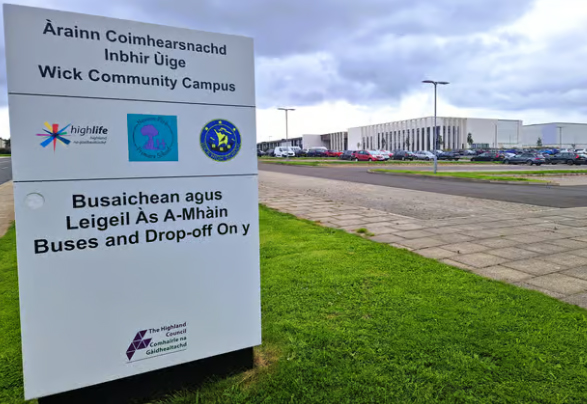
In Caithness, the Wick Joint Campus opened in 2017 at a cost of £48.5 million, bringing together Wick High School, Pulteneytown Academy Primary and South Primary into a single integrated site that houses a secondary and a primary school, a leisure centre and a library.
Improving services to the people
Convenor of the council Bill Lobban said the shift required a fundamental change in thinking of how council services and buildings are used.
“Gone are the days now when one building had a singular purpose,” he said.
Wick Community Campus is a multi-purpose site that includes education facilities and a leisure centre
“We have to start thinking outside the box. We closed a decrepit primary school and opened a brand-new one that includes the community leisure centre and the public library.
“We built a new football pitch. It means the place becomes the centre of the community.
“That’s what we’re trying to do in the Highlands.
“It’s not just about building a school, it’s about what else you can bring together.”
In 2017, Wick, one of the larger towns in the Highlands, saw the development of a campus home to various community services including schools, a library and a leisure centre | Katharine Hay
In Wick, council leaders said they are looking at introducing an NHS consultancy service in the same space where they have Department for Work and Pensions, Social Security Scotland among other council services to prevent people “being bounced about.”
A similar idea is coming together for Thurso, where plans are progressing for a £100 million campus that would combine schools with a wider range of community services including office spaces, health services and council depots.
source: The Scotsman