

Rob Mottram, Head of Product & Compliance at Robust UK, examines the door specification implications of the Terrorism (Protection of Premises) Act, commonly known as Martyn’s Law, for larger educational and public venues.
“When the Terrorism (Protection of Premises) Act 2025, known as Martyn’s Law, received Royal Assent in 2025, it marked a fundamental change in how public venues approach security. For schools and colleges, the implications extend far beyond policy documents and evacuation drills. They reach into the fabric of the building itself, an essential part of which is the doors.
Martyn’s Law is set to come into force in Spring 2027 and since it was announced, one question has come up repeatedly from educational establishments: does our existing door provision actually meet the mark? In most cases, the honest answer is: not yet. With just over six months before the Law is introduced, there are a number of factors that responsible persons in education settings need to consider when reviewing their specification.
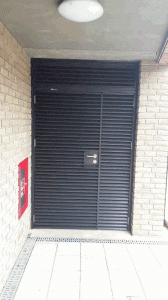
Why doors are central to compliance
Martyn’s Law is built around a deceptively simple principle: venues must take proactive steps to protect people from terrorist attacks. For larger venues such as those with a capacity of 800 or more, which encompasses most secondary schools, sixth form colleges and academies, this means implementing procedural and physical protective measures, as well as training staff and being able to demonstrate a credible, tested security plan.
Doors are an essential part of the plan. They control who enters, who exits and whether a building can be secured quickly and reliably under pressure. In a hostile threat scenario, a door is the first physical barrier between an attacker and the people inside. It is also the critical route through which occupants escape. Getting door specification right is not just a detail – it is the foundation.
From generic provision to purposeful specification
For many schools, door provision has historically been shaped by fire safety requirements and budget constraints rather than security performance. Martyn’s Law demands a different approach: one that is risk-led, layered and considers the specific role each door plays in an emergency.
Under a Martyn’s Law-compliant framework, schools should be thinking in terms of four distinct door functions:
- Entry control – managed access at perimeter and key internal thresholds, reducing the risk of uncontrolled ingress.
- Zoning and compartmentalisation – internal doors that create protected areas and break up open circulation routes.
- Lockdown capability – doors that can be rapidly and reliably secured to shelter occupants in place.
- Escape routes – doors that guarantee swift, unimpeded egress without compromising security from the outside.
This is a significant step away from the “one size fits all” approach to door provision. The new law requires schools to map their buildings and understand the threat profile and specify accordingly.

Balancing escape with shelter
One of the most important and most frequently overlooked distinctions in security door planning is the difference between evacuation routes and invacuation routes. Evacuation moves people out, whereas invacuation moves people in, to a place of shelter within the building.
Many hostile threat scenarios require invacuation rather than evacuation – locking down the building and sheltering in place may be the safest response. The doors serving those refuge areas must be capable of resisting forced entry for long enough to allow emergency services to respond, while simultaneously allowing safe internal movement.
The design challenge here is real. The same door that must resist attack from outside must still allow instant, single-action egress from inside. Achieving this reliably and consistently, across years of heavy daily use in a school environment requires tested, certified doorsets with hardware specified as a complete system, not assembled from unmatched components.
What makes a compliant doorset?
Martyn’s Law does not prescribe a specific doorset standard. What it does do is require responsible persons to demonstrate that their premises are protected to a proportionate level. When regulators and security assessors examine that evidence, they will look for:
- Third-party certified doorsets, not combinations of door, frame and hardware from different suppliers
- Appropriate resistance ratings based on site-specific risk assessment, from anti-intrusion performance to delayed-attack capability at higher-risk points
- Reliable locking systems that function under stress and in high-use conditions
- Dual compliance with fire and life safety regulations, security and fire performance must coexist, not conflict
- Panic hardware on escape routes, particularly in halls, dining areas, sports facilities and main corridors where large numbers of pupils may need to exit rapidly
That last point on hardware is worth further clarification. Panic hardware must be robust and tamper-resistant, simple to operate under pressure and fully integrated with the wider security and lockdown strategy. Poorly specified hardware, or hardware that has not been tested as part of the complete doorset, can undermine an otherwise sound security plan at the moment it matters most.
Who is responsible?
Under Martyn’s Law, legal responsibility rests with the ‘responsible person’ for the venue. In a school context, this is typically the responsible body, the academy trust, local authority, or proprietor in the case of independent schools, supported operationally by the headteacher and estates or facilities team.
That responsible person must ensure risk assessments are carried out, that appropriate physical and procedural measures are in place and that those measures remain effective over time. Critically, they cannot simply sign off a policy document and consider the duty discharged. Ongoing review, staff training, and the ability to demonstrate compliance to regulators are all part of the obligation.
In practice, this means estate and facilities managers need to be far more closely engaged with door specification than has traditionally been the case. It also means that specialist input, from security consultants and manufacturers with demonstrable expertise in certified doorset performance is not a luxury. It is part of discharging the duty appropriately.

Understanding what you already have
The first step for any school approaching Martyn’s Law compliance is an honest audit of existing door provision. The hard truth is that the majority of school doors, particularly in older buildings, were not specified with security performance in mind. Many doors lack structural integrity, third-party certification or any meaningful resistance to forced entry.
Some hardware upgrades are possible on existing doors, but they come with important caveats. Retrofitting a higher-specification lock to a door that was never designed for security does not produce a secure doorset. If the leaf itself lacks the structural strength to resist attack, the hardware is irrelevant. Gaps in compliance created by mixing certified and uncertified components can be just as dangerous as no security provision at all.
In higher-risk locations – main entrances, reception areas, external access points, and designated lockdown spaces the only reliable solution is often a full doorset replacement with a certified, tested system. This is an opportunity to invest in provision that will perform for decades and meets the school’s full compliance obligations from day one.
Specification for the long term
When specifying security doorsets for education environments, longevity and consistency of performance must sit alongside security rating. A school’s doors are in constant use, they are opened, closed, pushed, propped and misused many thousands of times a year. A doorset that performs perfectly when new but degrades under that kind of operational intensity is not a compliant doorset, it is a liability.
For education settings, we typically recommend certified steel doorsets, such as SECUR-DOR 2.1, at key external and high-risk internal locations. We also recommend internal steel doorsets for zoning, lockdown areas and protected corridors, which provide controlled access whilst supporting lockdown procedures without creating barriers to normal circulation.
It is essential that compliance be built into the specification, not retrofitted, not assumed and not dependent on the weakest component in an ad hoc assembly.
The time to act is now
Martyn’s Law is something which needs to be addressed now as the obligations on larger venues, including most secondary schools and colleges, is clear. Responsible persons who wait until the law is in place will find themselves facing difficult decisions under a time pressure to respond as the Act demands.
The schools that will gain the best outcomes are those which respond effectively and start the audit process now. Schools should engage specialist expertise early and approach door specification as a genuine investment in the safety of everyone on site.”
For guidance on specifying doorsets for education environments, visit: https://www.robust-uk.com/sectors/education/ or contact 01782 592900 / sales@robust-uk.com.
About Robust UK
Robust is the UK’s leading manufacturer of steel door solutions supplying the industrial, public and commercial sectors. With over 25 years of industry expertise, Robust specialises in delivering high-quality, bespoke steel door products tailored to meet the demands of every project, including comprehensive third-party certified fire-rated and security-rated options. Robust UK offers up to 10 years’ anti-corrosion warranty.
In 2019, Robust joined the Novoferm Group, Europe’s largest provider of door systems and part of the Sanwa Group, a world-leading manufacturer of entrance systems. This strategic partnership has strengthened Robust’s capabilities and expanded its reach within the global market, whilst maintaining the company’s commitment to innovation and quality that has defined its reputation for over two decades.
Operating from its facility in Newcastle-under-Lyme, Staffordshire, Robust continues to lead the industry in developing solutions that address real-world challenges faced by businesses requiring reliable, secure door systems.
Press enquiries/magazine editorial requests: Dragonfly PR Tel 0114 349 5341 marina@dragonflypr.co.uk or courtney@dragonflypr.co.uk.