Across the UK and Ireland, the pressures on education estate planners and construction clients are intensifying. Rising pupil numbers driven by demographic shifts, ageing school buildings nearing the end of their useful lives, mounting expectations for modern learning environments, and sharply constrained public capital budgets have become the defining characteristics of the current school building landscape.
In this context, traditional construction models — long on programme risk and sensitive to adverse weather and labour supply issues — are increasingly being called into question. What education clients now require are delivery approaches that combine certainty of programme, predictable cost, robust performance and sustainability. These needs represent both a challenge and an opportunity for innovation in how school buildings are conceived, designed and delivered.
One system that responds directly to these imperatives is Rapidschool by Creagh Concrete, a fast-track build solution developed specifically for the education sector. By combining off-site manufacturing with the inherent durability and performance of concrete construction, Rapidschool is positioning itself as a credible alternative to both traditional on-site builds and lightweight modular approaches. In doing so, it offers a pragmatic middle path that responds directly to the unique operational, performance and programme demands of education clients.
At the same time, major projects such as the £17.6 million extension to the University Collegiate School (UCS) in Bolton, delivered by Galliford Try’s Building North West division for the Department for Education (DfE), highlight how education infrastructure programmes are evolving in scale, ambition and delivery complexity across the UK.
Responding to Demand: Schools for Today and Tomorrow
The UK’s education estate is under pressure from all directions. Local authorities and academy trusts alike face the twin challenges of providing additional school places while also transforming learning environments to support 21st-century education. These pressures are most visible in areas experiencing population growth and urban regeneration, where ageing buildings, maintenance backlogs and enrolment pressures combine.
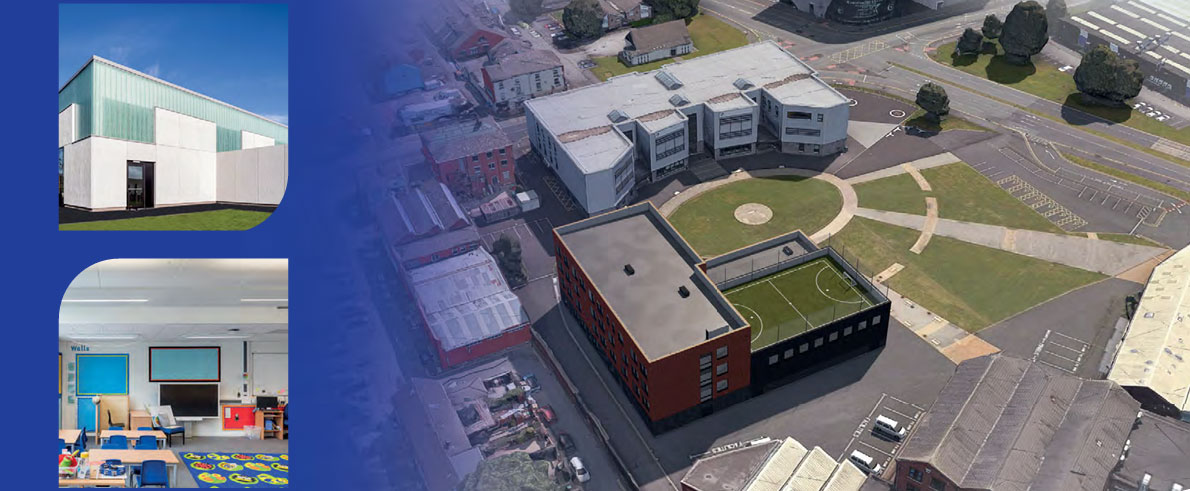
The UCS Bolton extension project illustrates this dynamic clearly. Procured by the DfE and valued at £17.6 million, the scheme includes a substantial extension delivering new teaching accommodation, dining areas, a kitchen, a sports hall and an activity studio. In addition, 1,086 square metres of internal refurbishment supports the school’s transition from a vocational focus toward a more academic curriculum. Collectively, these enhancements expand the available floorplate while modernising teaching spaces in response to evolving educational requirements.
This type of comprehensive upgrade — combining new build extension with refurbishment of existing facilities — is becoming increasingly common. Education providers are no longer focused solely on adding capacity; instead, they are seeking environments that inspire learners, support wellbeing, and accommodate a range of teaching styles and pedagogies.
Rapidschool: A System Designed for Education
Rapidschool was conceived with this complex and demanding context firmly in mind. Rather than being a repackaged modular product, it is a purpose-designed structural system developed specifically for schools. The system combines precast concrete crosswall elements with high-performance insulated sandwich panels, all produced and quality-controlled in an off-site manufacturing environment.
The result is a structural frame that delivers the inherent robustness of concrete — including longevity, fire resistance, acoustic separation and thermal mass — alongside the programme acceleration typically associated with modern methods of construction (MMC). This combination is particularly valuable in education settings, where buildings must withstand heavy daily use while maintaining high standards of safety and comfort.
Unlike lightweight panel systems that can struggle to meet stringent acoustic or fire performance requirements, the Rapidschool system is engineered from the outset to comply with the demanding standards expected in schools. These performance attributes are not optional extras; they are fundamental requirements in environments where safety, concentration and long-term durability are paramount.
Speed with Certainty
Time is one of the greatest constraints on any school construction project. Extended on-site programmes can disrupt school operations, increase costs, and expose clients to weather delays, labour shortages and material price volatility. For projects delivered on live school sites, prolonged construction activity can also affect safeguarding, logistics and day-to-day learning.
Rapidschool addresses these challenges through a delivery model based on parallel manufacturing and site works. While groundworks and foundations are undertaken on site, wall and floor elements are manufactured off-site under factory controlled conditions. This approach significantly reduces overall programme duration and, crucially, enhances certainty around delivery timelines.
Programme certainty is a critical advantage in the education sector, where funding windows are fixed and completion dates are often tied to academic calendars. The ability to plan confidently around term dates and handover milestones provides tangible operational benefits for school leaders and local authorities alike.
The UCS Bolton project, while delivered through a more conventional contracting model, also demonstrates the growing importance of accelerated delivery in education infrastructure. With a tightly defined programme and high levels of stakeholder engagement, progress toward completion reflects the wider sector’s emphasis on efficiency and predictability in school construction.
Cost and Value in a Constrained Funding Landscape
Public sector education clients operate within strict capital budgets, making cost certainty as valuable as speed. Academy trusts, local authorities and government departments must manage risk carefully, balancing ambition with affordability.
Rapidschool’s off-site manufacturing process reduces on-site labour requirements and minimises material waste, contributing to improved budget confidence. Factory production allows for tighter quality control, efficient use of materials and economies of scale, while reduced site duration mitigates exposure to adverse weather, inflation and labour availability issues.
Cost predictability is equally important in complex schemes such as UCS Bolton, where multiple project elements — including extension works, refurbishment, specialist facilities and live school interfaces — must be delivered within a fixed funding envelope. Such projects highlight the importance of delivery models that control risk without compromising design quality or performance.
Built-in Performance That Matters
Schools are not ordinary buildings. They demand high-performance solutions that address acoustic privacy, fire safety, thermal comfort and long-term durability under intensive use.
Concrete, as utilised within the Rapidschool system, is inherently well suited to these requirements. Its density and mass provide excellent acoustic attenuation, reducing noise transfer between classrooms and shared spaces. Concrete’s inherent fire resistance supports compliance with stringent regulatory standards, while its thermal mass helps moderate internal temperatures, contributing to occupant comfort and reduced energy demand.
These performance characteristics extend beyond regulatory compliance. Over the lifecycle of a school building, they deliver tangible operational benefits in terms of energy efficiency, maintenance and occupant wellbeing. In large-scale projects such as UCS Bolton, integrating high-performance materials supports both immediate functionality and long-term value.
Sustainability in Practice
Sustainability is now an expected component of school building projects, rather than an optional consideration. Rapid delivery methods must align with carbon reduction targets and resource-efficient construction practices.
Rapidschool incorporates low-carbon concrete options and responsibly sourced materials, while the controlled off-site manufacturing process inherently reduces waste and vehicle movements. These efficiencies deliver measurable reductions in embodied carbon and support wider sector commitments to decarbonisation.
Large-scale new build and refurbishment projects, such as UCS Bolton, often combine traditional construction techniques with MMC elements. These schemes broaden the conversation around how sustainability is achieved in practice, demonstrating the importance of balancing programme, cost, performance and carbon reduction within real-world constraints.
Architectural Flexibility and Design Quality
A common misconception surrounding off-site and precast solutions is that they limit architectural expression. In practice, the Rapidschool system offers significant design flexibility. It supports a wide range of planning layouts and functional requirements and integrates seamlessly with diverse architectural languages.
Externally, a variety of precast finishes — including smooth, textured, patterned and brick-faced options — allow architects to respond sensitively to context. This flexibility is particularly important on extension projects such as UCS Bolton, where new buildings must complement and enhance existing structures.
As a result, education clients are not forced to choose between speed and design quality. Well-considered off-site solutions can deliver both.
Towards a Future-Ready School Estate
The evolving landscape of school construction demands delivery models that provide certainty, performance, sustainability and design integrity. Rapidschool represents a promising direction by combining offsite precision with the proven durability of concrete construction in a system tailored specifically for education.
Meanwhile, projects such as the UCS extension in Bolton demonstrate how conventional delivery models are evolving to embrace complexity, stakeholder engagement and long-term performance. Together, these approaches reflect a broader shift toward pragmatic innovation in education infrastructure.
For those responsible for planning, funding and delivering school buildings, the message is clear: meeting today’s educational needs requires solutions that balance speed with substance. Systems like Rapidschool, alongside the strategic application of MMC within larger programmes, offer viable routes to building schools at the speed of need — with performance that endures.