
At the rate the government’s School Rebuilding Programme is currently rebuilding England’s most run-down schools, a school could wait 432 years for its turn.
The National Audit Office reported in 2023 that around 700,000 pupils were learning in schools that needed major rebuilding or refurbishment. It found that more than a third of school buildings had passed their estimated design life. Today, that figure remains the same.
Why the School Rebuilding Programme is struggling to keep pace
The School Rebuilding Programme was set up to address the worst cases, but it has repeatedly missed its own targets.
Government spending on school buildings has also run below planned levels for three consecutive years. The IFS attributes much of the shortfall to delays in the rebuilding programme itself. Over the course of this decade funding allocations have run more than 40 per cent below the government’s own assessment of what the estate needs.
This has left many schools waiting longer for essential improvements.
What the wait means for pupils
Research on classroom environments consistently links substandard conditions, including poor ventilation, inadequate heating and failing acoustics, to measurable reductions in concentration, attendance and attainment. These effects surface in the classroom every day a building goes unrepaired.
The RAAC crisis demonstrates the slow pace of school building improvements. More than a year after the government announced plans to remove the material from affected schools, 87% of the 237 schools identified had yet to complete the necessary work. The wider School Rebuilding Programme is also expected to take another three to five years to finish. This means many schools continue to wait for upgrades to their facilities.
Where faster-build methods are making a difference
For schools that cannot wait years for a conventional rebuild to reach them, modular construction has become one route to bringing new space into use sooner.
Portakabin designs and delivers modular school buildings. This ranges from single classrooms to complete schools. They are manufactured off-site and installed on location once the design and groundworks are ready. The approach is being used by schools across England facing exactly this kind of pressure.
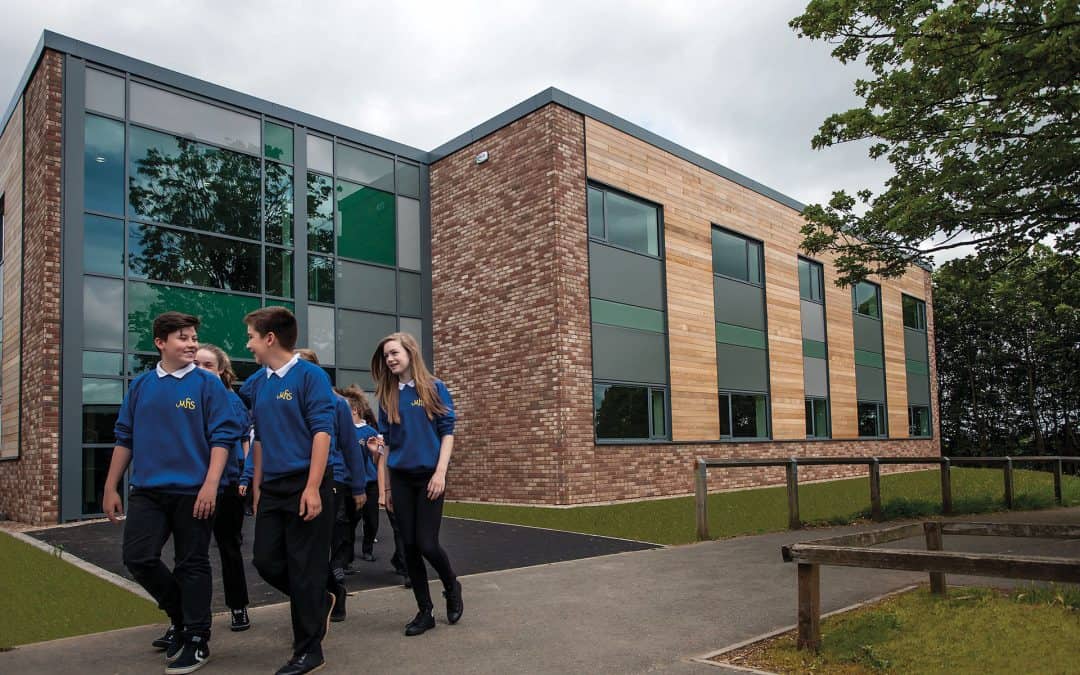
Holmes Chapel Comprehensive School, for example, discovered significant structural defects in its sixth form building. It received emergency funding only days before the new academic year. Initial plans for a modular replacement were drawn up within two days. The building was installed and fitted out in time for the start of term.
Denis Oliver, executive head at the school, said: “From the very beginning, Portakabin gave us complete confidence they could deliver exactly what we needed within our short timeframe. They seemed undaunted by the project challenges, and we knew their buildings offered the high standards we were looking for.”
Another example is Highgate Junior School in London. 65 modules were installed here to form a complete two-storey facility during construction of a new permanent building. Portakabin provided 16 general classrooms, two science laboratories, music and practice rooms, a library, IT suite, staff room and school office.
Principal, Mark James, said: “Since completion of the scheme, we have received universally positive feedback from parents, pupils and staff. The new building is bright and well designed and allows us to zone the year groups together. We are very happy with the building which is working well.”
Nick Griffin, divisional MD for GB Hire at Portakabin said: “For schools, a construction delay is about far more than a project running behind schedule. It can mean another term, or even another academic year, of pupils learning without the space or facilities they need. Offsite construction offers a way to compress delivery programmes, with high-quality, compliant buildings manufactured away from the school before being installed quickly on site. That means less disruption for pupils and staff, and greater certainty for schools planning around a critical deadline. Where time is of the essence, the way a building is delivered can make a real difference.”
A classroom that is ready when pupils need it
Any building used as a school, temporary or permanent, must meet the same regulatory standards. This includes Part M, the Equality Act, SENDA, Building Bulletins and BREEAM. A faster delivery method still must clear that same bar.
For the 700,000 pupils currently learning in schools that need major work, the practical question is how soon a working classroom actually arrives. At 432 years per cycle for the slowest route, speed becomes the measure that decides whether a generation of pupils is taught in the conditions they are owed.
While schools wait for long-term School Rebuilding Programme projects, pupils still need safe and effective learning environments. Maintaining high-quality teaching spaces remains a priority