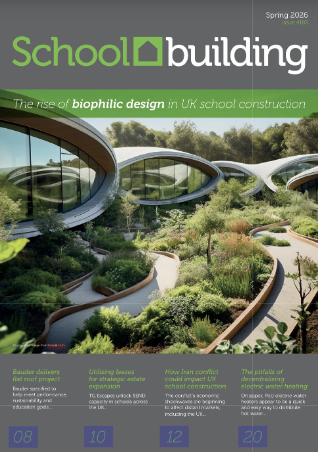
While the UK construction industry focuses on the practical challenges of the £38 billion Education Estates Strategy – RAAC removal, net-zero upgrades, and the School Rebuilding Programme – a more fundamental question is gaining quiet momentum: how much does the building itself shape what happens inside it? Emerging evidence from rigorous UK studies shows that thoughtful classroom design can explain up to 16% of the variation in pupil progress and wellbeing, a figure that rivals many teaching interventions. School Building Magazine Editor Joe Bradbury investigates:
This is not about extravagant features or inflated budgets; it is about applying proven principles around light, air, acoustics, flexibility, and personalisation that turn ordinary spaces into powerful learning environments. For contractors, architects, and estates teams, the “16% factor” represents an opportunity to move beyond compliance and deliver measurable gains in attainment, attendance, and mental health. As the next wave of school projects takes shape, understanding this evidence could redefine what “good” school construction really means.
The landmark research that changed the conversation
The most influential study in this field remains the 2015 University of Salford research, which assessed 153 classrooms across 27 English primary schools and tracked the progress of 3,766 pupils. Using sophisticated multi-level statistical modelling, the team isolated seven key design parameters that together explain 16% of the variation in academic progress – a remarkable finding when you consider that pupil attainment is influenced by countless factors including teaching quality, home environment, and prior attainment.
The researchers organised their findings around the SIN framework – Stimulation, Individualisation, and. Naturalness. Naturalness (light, temperature, and air quality) accounts for roughly half the impact.
Individualisation and stimulation each contribute around a quarter. The study emphasised that the classroom itself matters more than the wider building, supporting an “inside-out” approach to design. In simple terms, the spaces where children spend most of their day have a quantifiable, non-trivial effect on how well they learn.
This 16% figure is not a ceiling. Earlier work cited in broader reviews suggests overall design impacts can reach 25% when exterior and interior elements combine effectively. For an industry delivering hundreds of new and refurbished schools under current programmes, these percentages represent thousands of pupils whose life chances could be meaningfully improved through better design decisions.
Naturalness: the foundation of effective learning spaces
The strongest driver is naturalness – the basic environmental conditions that allow young bodies and minds to function at their best. Natural daylight tops the list. A widely referenced 1999 study found that classrooms with high levels of daylight improved maths performance by 20% and reading literacy by 26%. Simple measures such as larger windows, curtain walling, and careful orientation deliver outsized returns. Temperature control follows closely.
Extremes of heat or cold impair concentration and increase fatigue. Well-designed ventilation – whether natural or mechanical – maintains comfortable ranges while reducing energy costs over time. Closely related is air quality. Research consistently shows that elevated carbon dioxide levels correlate with lower attendance and slower task completion.
Improvements to heating, ventilation, and air-conditioning systems have been linked to reductions in absence (around 3% in some analyses), fewer behavioural incidents, and modest gains in maths and reading scores. Acoustic comfort also falls under this umbrella. Classrooms free from intrusive noise support clearer communication and sustained focus – particularly important in inclusive settings where pupils with additional needs are present.
When these natural elements are optimised together, the cumulative effect on pupil wellbeing and readiness to learn is substantial.
Individualisation and stimulation: creating spaces that belong to children
Beyond basic environmental comfort lies the need for spaces that feel personal and engaging. Ownership – the sense that a classroom belongs to its occupants – emerges through personalisable areas, comfortable and adaptable furniture, and displays that reflect the children themselves. Pupils in such environments show higher engagement and emotional security.
Flexibility is equally critical. Rigid layouts designed for traditional whole-class teaching struggle to accommodate modern pedagogies such as group work, independent study, or movement-based learning. Movable partitions, multi-use zones, and adaptable furniture allow schools to respond to changing needs without constant capital expenditure. Stimulation balances complexity and colour. Too little visual interest leads to boredom and reduced attention spans; too much creates distraction and eye strain.
Thoughtful use of colour, texture, and moderate complexity – combined with calming elements – sustains focus while reducing fatigue. Studies highlight that quiet, colourful spaces stimulate positive emotions and prepare children psychologically for learning far more effectively than stark or institutional environments.
Wellbeing and the post-pandemic imperative
The evidence base has expanded since the Salford study, particularly around mental health and resilience. Post-pandemic research from University College London and others emphasises that school design must now explicitly support emotional wellbeing.
Dedicated, private spaces for counselling, mindfulness, or small-group support reduce stigma and provide vital respite. Outdoor connections and biophilic elements – views of nature, natural materials, and accessible green space – draw on attention restoration theory to lower stress and improve concentration.
Six key propositions emerging from stakeholder work in the UK call for wellbeing to become a formal measure of school success, generous and flexible space standards, stronger community integration, and generous outdoor learning environments. These are not luxury add-ons; they are evidence-backed responses to rising pupil anxiety, persistent absence, and the need for schools to serve as community anchors.
What this means for the construction industry
For contractors and consultants working on education projects, the message is both liberating and challenging. Evidence-based design does not require exotic materials or inflated budgets. It demands intelligent application of proven principles: prioritising daylight in early sketches, specifying ventilation strategies that work with rather than against the building fabric, and collaborating early with educators to embed flexibility and ownership. The current wave of estates renewal offers a once-in-a-generation chance to apply these insights at scale.
Rather than defaulting to standardised templates, teams that integrate the seven parameters and wellbeing considerations can demonstrate tangible returns – better pupil outcomes, reduced maintenance issues, and stronger community support. Frameworks that reward whole-life value rather than lowest initial cost will increasingly favour those who understand the 16% factor.
In summary
Of course, barriers remain. Legacy buildings – many constructed before 1976 – constrain options, while tight capital budgets tempt corners to be cut on “soft” design elements. Yet the data shows that short-term savings often translate into long-term costs through poorer attendance, higher staff turnover, and missed attainment gains.
The solution lies in better briefing, early involvement of design specialists who understand the research, and robust post-occupancy evaluation to close the feedback loop.
As condition data collection evolves and responsibility for ongoing estate management strengthens, those in the construction supply chain who champion evidence-based approaches will find themselves not just delivering buildings, but shaping futures. Ultimately, school construction is about more than bricks and mortar. It is about creating environments where young people can flourish academically, emotionally, and socially. The evidence has been clear for years; the opportunity to act on it has never been greater.
By embedding the 16% factor into every decision, the UK’s school building industry can move from simply replacing ageing stock to actively enhancing the nation’s educational outcomes for decades to come.
sources: https://schoolbuilding.org.uk/
image: Freepik